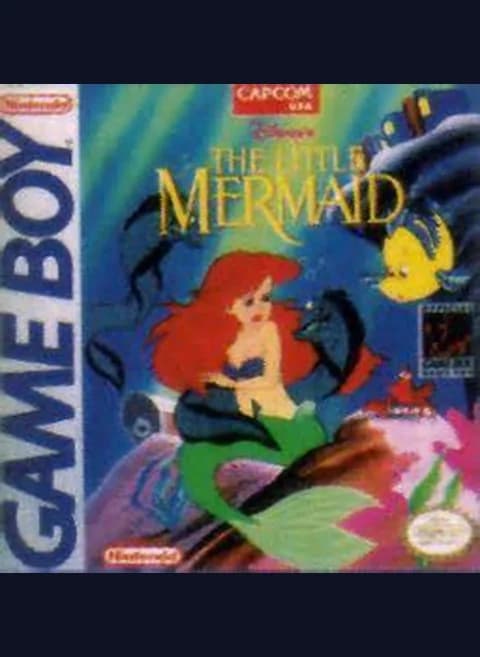
About The Little Mermaid
| Released | July 1991 (Japan and North America) |
|---|---|
| Publisher | Capcom |
| Game Boy conversion | credited as Great |
| Game Boy music | Hitoshi Sakimoto |
| Producer | Tokuro Fujiwara |
| Re-release | Player's Choice, 1997 (North America) |
| Genre | Action |
Capcom's handheld Little Mermaid arrived alongside the NES edition in July 1991, converted by a studio credited as Great, with Hitoshi Sakimoto writing the Game Boy score instead of Yasuaki Fujita's NES music.
The six-stage route to Ursula is intact, and the changes are presentational: Ariel begins each stage already in position rather than drifting down into it, backgrounds are plainer, spent hearts vanish instead of leaving empty frames, and the music loops from the start at a slower tempo. Nintendo Power scored this version 13.4 out of 20 against the NES release's 15.3, GB Action gave it 68%, and North America saw a Player's Choice reissue in 1997.
Controls
- Arrow keys = D-pad
- Z = A button
- X = B button
- Enter = Start
- V = Select
- 1 = quick save state, 2 = quick load, 3 = change save slot (saved in this browser)
- Every key can be remapped in the emulator's Control Settings; USB/Bluetooth gamepads work too
- On phones/tablets, turn on the on-screen touch gamepad from the game page
Tips
- Trapped enemies are ammunition: bubble one, then hurl it into the next.
- Dig the sand whenever a stretch looks empty; chests and extra range are buried rather than placed.
- Keep the bubble power-ups coming. Range decides whether you can hit Ursula's guards before they close in.
FAQ
- How does the handheld edition differ from the NES cartridge?
- Same stages and rules, different presentation: no drop-in entrance, flatter backgrounds, hearts that disappear when lost, and slower, looped music.
- Who wrote the handheld soundtrack?
- Hitoshi Sakimoto, while Yasuaki Fujita handled the NES score.
Sources
Last updated:
Player comments
0 approvedNo public comments yet. Share a memory from this game.