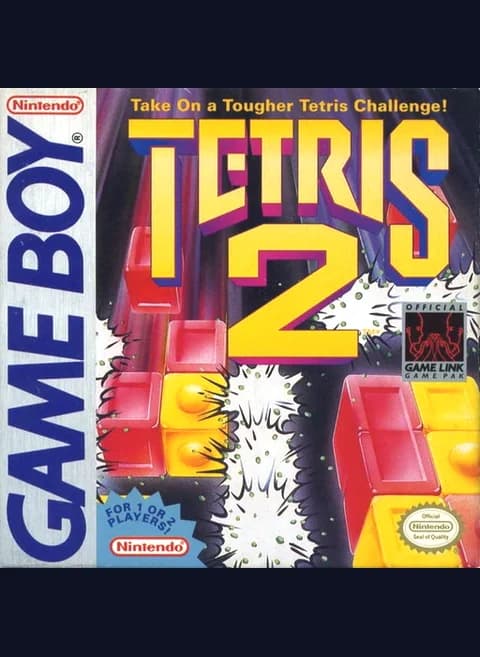
About Tetris 2
| Released | December 1993 (North America); June 14, 1994 (Japan); October 27, 1994 (Europe) |
|---|---|
| Developer | Tose |
| Publisher | Nintendo |
| Japanese title | Tetris Flash |
| Two players | Game Link Cable |
| Genre | Puzzle |
Tetris 2 keeps the falling tetrominoes and changes the target: instead of completing lines, you clear three blocks of one colour, Dr. Mario fashion, and some pieces only touch at their corners.
Tose developed it and Nintendo published: North America got the cartridge in December 1993, Japan followed on 14 June 1994 as Tetris Flash, Europe on 27 October 1994. Nintendo Power singled out the two-player Game Link Cable mode as the handheld version's strength while calling the graphics bland. It topped the American Game Boy sales chart in January and February 1994 and the British one in August that year.
Controls
- Arrow keys = D-pad
- Z = A button
- X = B button
- Enter = Start
- V = Select
- 1 = quick save state, 2 = quick load, 3 = change save slot (saved in this browser)
- Every key can be remapped in the emulator's Control Settings; USB/Bluetooth gamepads work too
- On phones/tablets, turn on the on-screen touch gamepad from the game page
Tips
- Build downward from existing colour clusters instead of laying pieces flat and hoping the colours meet.
- Pieces that join only at a corner still count as one shape, so leave a diagonal slot when a colour gap looks closed.
- Two-player link matches punish stacking: keep your own column low and let the other board fill.
FAQ
- Is this the same as the NES Tetris 2?
- Same game and rules; the handheld release has its own graphics, music and link-cable two-player mode.
- Why is it called Tetris Flash in Japan?
- Tetris Flash is the Japanese title of this 1993 game; the cartridge itself only uses Tetris 2 in the West.
Sources
Last updated:
Player comments
0 approvedNo public comments yet. Share a memory from this game.