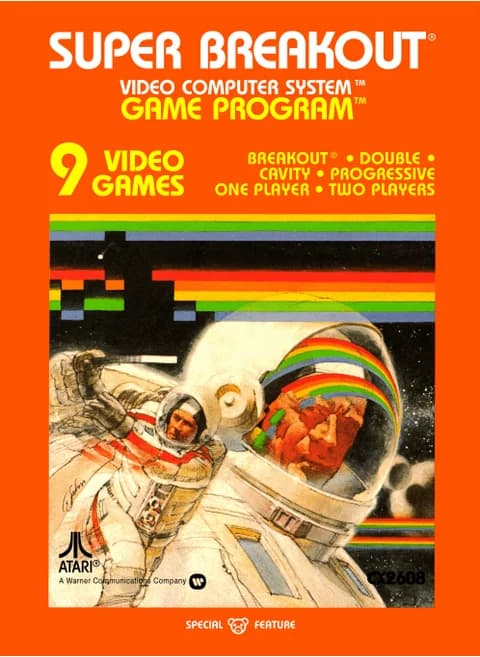
About Super Breakout — Paddle / Fixed
| Model | CX2608 |
|---|---|
| Publisher | Atari, Inc. |
| 2600 programmers | Nick Turner, Carol Shaw |
| Released | October 1981 (Sears), January 1982 (Atari label) |
| Players | 1-2 |
| Controllers | One pair of Atari Paddle Controllers |
| Game numbers | 9 |
| Full wall | 416 points |
Super Breakout on the 2600 wants a pair of paddle controllers, not a joystick: the knob slides the bat across the bottom of the screen and the button serves. Atari shipped the cartridge in October 1981 as a Sears Tele-Games exclusive, then put it under its own label in January 1982, with Nick Turner credited on the 2600 program. The retail Atari cartridge carries model CX2608.
Nine game numbers cover four ideas. Two are plain Breakout, one or two players; two are Double, which stacks two bats and serves two balls at once; two are Cavity, where two balls sit trapped inside the wall and double or triple every brick once freed; one is Progressive, a single-player wall that creeps downward in bands of four rows. The last two are Children's Versions, running slower with a bat that never shrinks.
Bricks pay by row: one point each in the top two rows, then three, five and seven going down, 416 for a full wall. The bat halves the moment the ball breaks through the top row and touches the ceiling, and the ball quickens after the sixteenth hit and again after the forty-eighth, so a long rally is a countdown. Difficulty B doubles the bat width for beginners; A is the size veterans expect. Atari's earlier Breakout was the bare wall of bricks; this cartridge adds the three variants, while the 5200 pack-in and the Game Boy release are separate builds played with a stick and a d-pad.
Controls
- Arrow keys = joystick
- X = fire button
- Enter = console Reset switch (starts a game)
- V = console Select switch (cycles game modes)
- Q / Tab = left difficulty A / B; E / R = right difficulty A / B
- 1 = quick save state, 2 = quick load, 3 = change save slot (saved in this browser)
- Every key can be remapped in the emulator's Control Settings; USB/Bluetooth gamepads work too
- On phones/tablets, turn on the on-screen touch gamepad from the game page
Tips
- Break through a corner rather than the middle; the ball settles into a repeatable line and the wall opens faster.
- Expect the return to speed up once the ball starts hitting the bottom four rows, so keep the bat centred before that happens.
- When the bat halves, make small corrections with the knob instead of sweeping it across the screen.
- Stay on difficulty B, with the double-width bat, until the sixteenth-hit speed-up stops catching you out.
FAQ
- Can this cartridge be played with a joystick?
- No. It needs a pair of paddle controllers plugged into the left port; the knob moves the bat and the button serves.
- Why does the bat suddenly shrink?
- Breaking through the last row and touching the top boundary halves it until the turn ends, except in the two Children's Versions.
- Is this the same game as the 5200 or Game Boy version?
- The rules are shared but the builds are separate: the 5200 pack-in uses the console's analogue stick, and the Game Boy release uses a d-pad.
Sources
- AtariAge: Super Breakout label page (CX2608)
- AtariAge: Super Breakout 2600 manual
- Wikipedia: Super Breakout
Last updated:


Player comments
0 approvedNo public comments yet. Share a memory from this game.