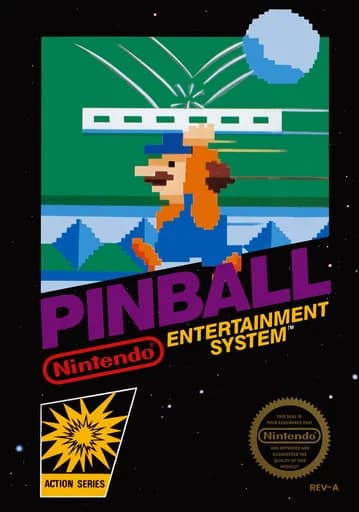
About Pinball
| Released | 2 February 1984 (Japan); 18 October 1985 (North America) |
|---|---|
| Developer | Nintendo R&D1, HAL Laboratory |
| Publisher | Nintendo |
| Genre | Pinball |
Pinball started life as a Game & Watch unit, and Nintendo rebuilt it for the Famicom on 2 February 1984 with Satoru Iwata programming. North American players met it on 18 October 1985 as one of the NES launch titles. The table is split across two screens: fire the ball up with the plunger, keep it alive with flippers on both halves, and drop it through the opening at the top of the lower screen to send it back upstairs. A bonus hole opens a Breakout-like round where Mario carries a platform and tries to catch Pauline as the floor beneath her breaks away. More than a million cartridges were sold, and a VS. arcade version followed in 1984.
Controls
- Arrow keys = D-pad
- Z = A button
- X = B button
- Enter = Start
- V = Select
- 1 = quick save state, 2 = quick load, 3 = change save slot (saved in this browser)
- Every key can be remapped in the emulator's Control Settings; USB/Bluetooth gamepads work too
- On phones/tablets, turn on the on-screen touch gamepad from the game page
Tips
- The plunger launches from the lower table; the ball only reaches the upper screen through the opening at the top.
- Hitting the bonus hole starts the Mario round: bounce off his platform to clear the blocks, then catch Pauline before she lands.
FAQ
- Was Pinball an NES launch title?
- Yes. The cartridge shipped with the North American NES launch on 18 October 1985, about a year and a half after the Japanese Famicom release in February 1984.
- Who programmed the NES version?
- Satoru Iwata and Satoshi Matsuoka are credited as the programmers.
- What is the bonus stage?
- A hole on the table drops you into a Breakout-style round where Mario holds a platform and Pauline falls once the blocks under her are gone.
Sources
Last updated:
Player comments
0 approvedNo public comments yet. Share a memory from this game.