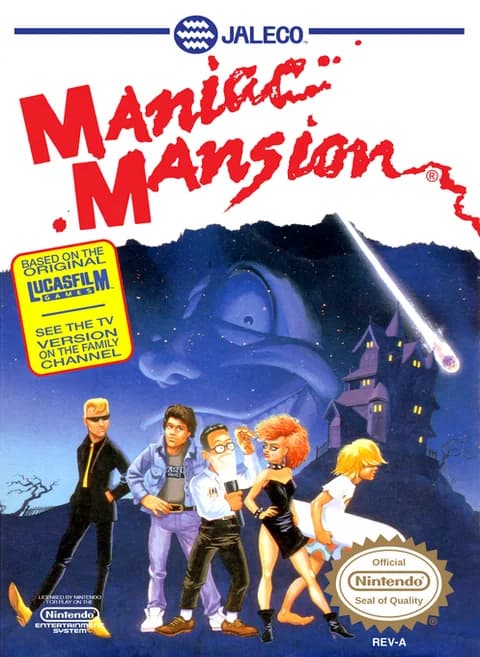
About Maniac Mansion
| Released | September 18, 1990 (North America) |
|---|---|
| Developer | Lucasfilm Games, Realtime Associates |
| Publisher | Jaleco |
| Genre | Graphic adventure |
| Save | Battery-backed save in the cartridge |
| Original release | October 5, 1987 (Commodore 64, Apple II) |
Maniac Mansion reached the NES in September 1990, built by Lucasfilm Games with Realtime Associates and published by Jaleco. It is not the 1987 computer game with a new coat of paint: Nintendo's content review forced edits all through the port — graffiti shortened to leave only its puzzle hint, a swimsuit calendar and a mummy pin-up repainted, dialogue softened — yet the design survives intact. Pick Dave plus two of six friends, then work a nonlinear mansion through a verb menu instead of typed commands.
The port redraws every room to the console's resolution, adds continuous chiptune music from George Sanger's band, and saves progress to a battery inside the cartridge. Jaleco's earlier Japanese edition, released in 1988, had gone its own way with cuter art, flip-screen rooms and a 104-character password.
Controls
- Arrow keys = D-pad
- Z = A button
- X = B button
- Enter = Start
- V = Select
- 1 = quick save state, 2 = quick load, 3 = change save slot (saved in this browser)
- Every key can be remapped in the emulator's Control Settings; USB/Bluetooth gamepads work too
- On phones/tablets, turn on the on-screen touch gamepad from the game page
Tips
- Choose the pair by obstacle, not by taste: Bernard repairs appliances, and Syd and Razor can play the instruments the mansion asks for.
- Pick up everything and try it on everything — the verb menu makes experiments free, and several puzzles only open up that way.
- The hamster in the microwave survived Nintendo's edits and was removed from later shipments, so it is worth trying once on an early cartridge.
FAQ
- Is this the same as the computer version?
- Same design and puzzles, but reworked for Nintendo's content standards, with redrawn art, new music and a battery save instead of disk saves.
- Why was so much changed?
- Nintendo of America judged the original's profanity, nudity and dialogue unsuitable for children; Lucasfilm cut them while keeping the puzzle hints.
- What is different in the Japanese version?
- Jaleco's 1988 Japanese port has cuter character art, flip-screen rooms instead of scrolling, and a 104-character password for saving.
Sources
Last updated:
Player comments
0 approvedNo public comments yet. Share a memory from this game.