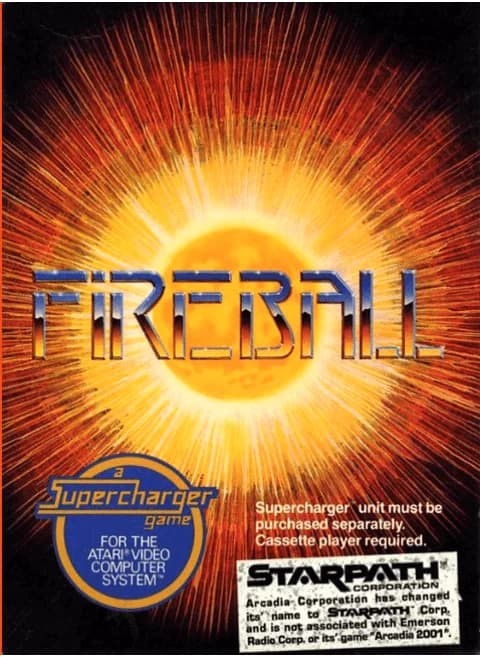
About Fireball (1982) — Paddle
| Platform | Atari 2600 |
|---|---|
| Publisher | Arcadia, renamed Starpath during development |
| Designer | Scott Nelson |
| Release | August 1982 |
| Genre | Block-breaking |
| Playfields | Five |
| Players | One to four, taking turns |
| Controllers | One pair of Atari paddle controllers, left port |
| Catalogue number | AR4300 |
Fireball is a block-breaking game for the Atari 2600, designed by Scott Nelson and published by Arcadia in 1982; the company took the name Starpath while the game was in production. Like the other Supercharger titles it came on cassette and needed the Starpath Supercharger in the cartridge slot, which read the program from a tape recorder into its own memory.
The bat is replaced by a juggler standing along the bottom of the screen. Two paddles occupy the left port; the knob slides him sideways and the red button throws a held ball back at an angle. He carries one ball in each hand, and keeping the button down deflects a ball straight away instead of catching it. Each set of blocks you clear adds another ball, up to six in play, and three quick presses add one at any time.
The cassette holds five playfields: Cascade, Firetrap, Knock-A-Block, Marching Blocks and Migrating Blocks. A game gives five tries, up to four players take turns for the high score, and the difficulty switch on A asks for more precise catches.
Controls
- Arrow keys = joystick
- X = fire button
- Enter = console Reset switch (starts a game)
- V = console Select switch (cycles game modes)
- Q / Tab = left difficulty A / B; E / R = right difficulty A / B
- 1 = quick save state, 2 = quick load, 3 = change save slot (saved in this browser)
- Every key can be remapped in the emulator's Control Settings; USB/Bluetooth gamepads work too
- On phones/tablets, turn on the on-screen touch gamepad from the game page
Tips
- Read the angle of a falling ball early and slide under it before it arrives, rather than chasing it at the last moment.
- Once three or more balls are loose, hold the button down and let them bounce off you instead of catching every one.
- Blocks higher on the wall are worth more, and every block's value rises as the number of balls in play goes up.
- Setting the difficulty switch to A instead of B makes the game harder, since catches then call for more precision.
- A mystery ball turns up every so often on the Marching Blocks playfield, so keep an eye out for it.
FAQ
- Why does the joystick do nothing?
- The cassette was written for paddle controllers rather than a joystick; they use the left controller jack, with the knob moving the juggler and the red button throwing.
- How many balls can be in play at once?
- Six. Each cleared set of blocks adds another, and three quick presses on the button add one immediately.
- Which playfields are on the cassette?
- Cascade, Firetrap, Knock-A-Block, Marching Blocks and Migrating Blocks. Each can be played by one to four people taking turns.
Sources
Last updated:


Player comments
0 approvedNo public comments yet. Share a memory from this game.