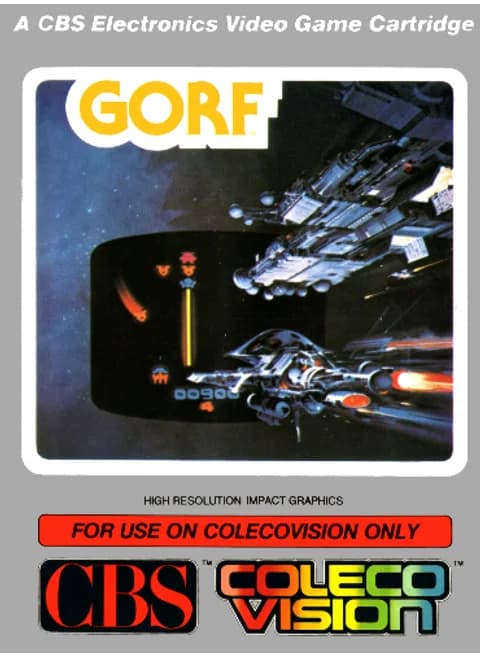
About Gorf
| Publisher | Coleco |
|---|---|
| ColecoVision conversion | Nuvatec |
| Released | May 1983 |
| Arcade original | Midway, February 1981 |
| Arcade design | Jamie Fenton, Dave Nutting Associates |
| Genre | Fixed shooter |
| Ranks | 6 titles from Cadet up to Space Avenger |
| Revisions before approval | 39 |
Coleco's ColecoVision cartridge of Gorf shipped in May 1983, with Nuvatec handling the conversion from Midway's 1981 coin-op. Getting it accepted took work: the port passed through 39 revisions before Coleco's product evaluator Jodi McIlroy signed off, each change small, the aim being to get the feel right rather than to redraw the game.
The source material came from Dave Nutting Associates, designed by Jamie Fenton and distributed by Midway from February 1981. Fenton built five missions that each play by their own rules: an opener staged over Earth behind a shield that drops whenever your own shot crosses it, a duel with two formations of five, a warp with attackers streaming out of the centre, and a flagship whose underside has to be shot away before the core inside can be hit.
Two things separate it from its neighbours. The ship slides anywhere across the lower part of the screen rather than shuttling along one line, and it carries a single laser bolt, so pulling the trigger again cancels the shot already in the air. Finishing a full cycle of missions raises your Gorf title one step at a time (Cadet first; Captain and Colonel next; General later; Warrior after that; Space Avenger last), and every promotion speeds the enemies up. One arcade mission is missing here: the Galaxian imitation could not travel, since Namco owned that property. Electronic Games judged this the strongest home edition of the game to that point, faulting only the sound effects.
Controls
- Arrow keys = joystick
- X = left (yellow) fire button
- Z = right (red) fire button
- In game: stick aims the ship; X or Z fires along the mission stages
- 1–8 = keypad 1–8, Enter = keypad *, V = keypad #
- Number keys 1–8 are the Coleco keypad on this system, so the 1/2/3 save-state hotkeys don't apply; use the emulator menu to save/load states
- Every key can be remapped in the emulator's Control Settings; USB/Bluetooth gamepads work too
- On phones/tablets, turn on the on-screen touch gamepad from the game page
Tips
- Only one bolt exists at a time: pressing fire again wipes the shot still travelling, so fire in a rhythm instead of mashing.
- In the opening mission the shield goes down for a moment while your shot passes through it, and enemy fire gets in during that window — time the interval.
- Peel the flagship from the bottom. Hits elsewhere only break pieces loose, and those pieces fly off at random and can take you with them.
- Every completed cycle promotes you and speeds everything up; treat the first loop as practice for the ranks that follow.
FAQ
- Which arcade mission is missing?
- The Galaxian-style stage. Namco held the rights to Galaxian, so the mission never travelled to the home systems.
- How many ranks are there?
- Six titles. You begin as Cadet; clear a full mission cycle to move up, and the last title is Space Avenger. Higher titles also speed the enemies.
- Does the ColecoVision version talk?
- No. The taunts came from speech chips in the arcade cabinet, and only the Commodore 64 port had speech hardware on the home side. Reviewers praised the graphics here, not the sound.
Sources
Last updated:
Player comments
0 approvedNo public comments yet. Share a memory from this game.